



Today, selecting an electronic document management system (EDMS) is a strategic decision that determines a company’s operational resilience, decision-making speed, and ability to scale without sacrificing efficiency. In this context, it is important to evaluate not only the system’s functionality but also its integration capabilities, platform maturity, and the solution’s readiness to support the company’s long-term growth.
According to Global Information Inc., a company that aggregates global market research, the electronic document management systems segment continues to expand and may surpass $12 billion in the coming years, driven by an annual growth rate of 14.6%. This momentum is fueled by remote work, the need for shared file access, growing demand for deeper analytics, automation powered by AI and ML technologies, and stricter data governance requirements.
As a result, companies should choose a solution that will remain relevant not only a year from now but five years down the line — together with a partner capable of supporting ongoing development rather than ending the collaboration immediately after the implementation project is completed.
Why Choosing the Right EDMS matters today?
Document management is no longer just an operational function — it directly impacts decision-making speed, regulatory compliance, and a company’s overall competitiveness. Several factors are prompting businesses to reassess how they handle documents today:
- Growing data volumes (77 million terabytes of data are created globally every day) — companies are working with ever-expanding volumes of information, including contracts, financial reports, HR records, and internal policies. This growth is driven by multiple factors: business processes are expanding, new products and markets are emerging (automatically generating more documentation), regulatory requirements mandate retaining significantly more reports and archives, hybrid and remote work create additional digital footprints in the form of requests, approvals, and internal communications, integrations with ERP, CRM, and HRM systems introduce new data streams, and companies increasingly rely on analytics for decision-making — prompting them to collect and store more metrics. As a result, paper-based processes cannot keep up with this load, while disorganized storage in file folders leads to time loss and errors.
- The cost of errors — in an environment where every contract or report carries legal weight, even a minor inaccuracy can be expensive. A lost document, duplicate versions, or a missed approval deadline represent tangible financial and reputational risks.
Forbes, citing research by Ardent Partners — a research and consultancy company — notes that the average cost of manually processing an invoice is approximately $10.89 per document. This figure escalates quickly when hundreds or thousands of documents flow through a company each month, clearly demonstrating how even a single inefficiency can translate into substantial financial losses. Importantly, this refers to traditional processing methods based on manual tasks and paper workflows. By contrast, automating document management with specialized DMS solutions equipped with AI tools helps reduce such costs.
Another Forbes article reports that an AI-powered invoice automation platform can process more than $1 billion in invoices annually, saving companies around 15,000 working hours and delivering a positive return on investment within the first year of system adoption.
- Security requirements and regulatory pressure — legislation in the financial, healthcare, and public sectors requires organizations to retain far more documentation than in the past, including reports, audit records, archives, and electronic signatures. For example, banks and insurance companies must retain transaction histories, loan files, and audit reports for 5–10 years to support potential inspections. Healthcare providers are required to store electronic patient records, test results, and treatment histories in accordance with confidentiality regulations (such as HIPAA in the U.S. or GDPR in the EU), since even a single data breach can lead to litigation. Government institutions must archive meeting minutes, directives, decisions, and procurement documentation to ensure auditability and transparency in public spending. Moreover, the shift to electronic document management has introduced new requirements: organizations must retain not only the document itself but also proof of its authenticity — including electronic signatures, certificates, and user activity logs. This ensures the document’s legal validity in the event of disputes and makes regulatory compliance a critical business priority. As a result, companies need systems that guarantee information protection, access control, and full transparency of user actions.
- Flexible work models — modern companies operate in hybrid environments, with some employees in the office and others working remotely. This means documents must be accessible from any device and location while remaining securely protected. Such an approach fundamentally reshapes the requirements for document management systems: they must provide secure access, real-time synchronization, and process transparency regardless of where teams are located.
Forbes, citing research by Wakefield Research and Elastic, reports that amid the widespread shift to remote work in 2021, more than 50% of professionals said they spent more time searching for the files they needed than actually performing their core tasks. Similar findings are highlighted by HRD America: according to survey results, employees spend roughly 25% of their workweek simply searching for documents. This clearly demonstrates that without modern DMS solutions featuring rapid access and intelligent search capabilities, flexible work models can quickly become a source of productivity loss.
- Pressure for efficiency — the market demands speed. This is particularly evident in industries where responsiveness is a critical competitive advantage. For example, in procurement or tendering, a company that approves documents within hours can secure a contract ahead of competitors that spend several days on the same processes. In the financial sector, delays in approving payment documents may result in a failed deal or a lost client, whereas automated electronic document management systems enable approvals in real time. This illustrates that the speed of document workflows directly affects both internal efficiency and a company’s ability to maintain its market position.
Therefore, the need to rethink document management today is driven less by the pursuit of convenience and more by the necessity to respond to real-world challenges: the rapid growth of data volumes, increasing regulatory requirements, flexible work models, and the demand for faster processes. Together, these factors create sustained demand for electronic document management systems and define their role as a core component of modern business infrastructure.
How to Choose an Electronic Document Management System? Criteria and market challenges
Selecting an electronic document management system (EDMS) is a strategic decision that requires a careful approach, taking several key criteria into account:
Integrations
The key criterion for selection is the platform’s ability to seamlessly exchange information with ERP, CRM, and accounting & HR software. A well-designed integration eliminates the need to enter the same data multiple times, which drastically reduces errors and speeds up decision-making processes.
Functional capabilities
Ensure that the system supports all core processes: creating, editing, approving, signing, and archiving documents. An additional advantage is integration with CRM, ERP, or accounting software your company already uses or plans to integrate into a unified IT ecosystem.
Scalability
The chosen solution must grow with your business. If you currently handle a few dozen documents, tomorrow that number could be in the hundreds. Opt for a solution that adapts easily to increased volumes without requiring complex or resource-intensive modifications.
Scalability isn’t just about handling larger workloads — it’s also about functional flexibility. A modern DMS solution should adapt to the specific needs of each company:
- Allow configurable approval workflows
- Support various document types and usage scenarios
- Provide a flexible interface that adjusts to roles and processes
- Integrate easily with other systems via connectors and open APIs
Particular attention should be paid to well-documented APIs and architecture that enables companies to integrate independently with the DMS and extend its functionality. The vendor should provide access to documentation, expertise, personalized workshops, and ongoing support, including post-project assistance.
Scalability is a multi-level approach, encompassing:
- Technological — the system handles increased loads reliably
- Functional — the ability to adapt and extend features according to company needs
- Service — access to support, consulting, and user training
- Integration — seamless connection to internal and external systems via APIs and connectors
A truly scalable system is a platform designed to grow with your business: increasing document volumes, user numbers, and process complexity without requiring constant major modifications.
AI Capabilities
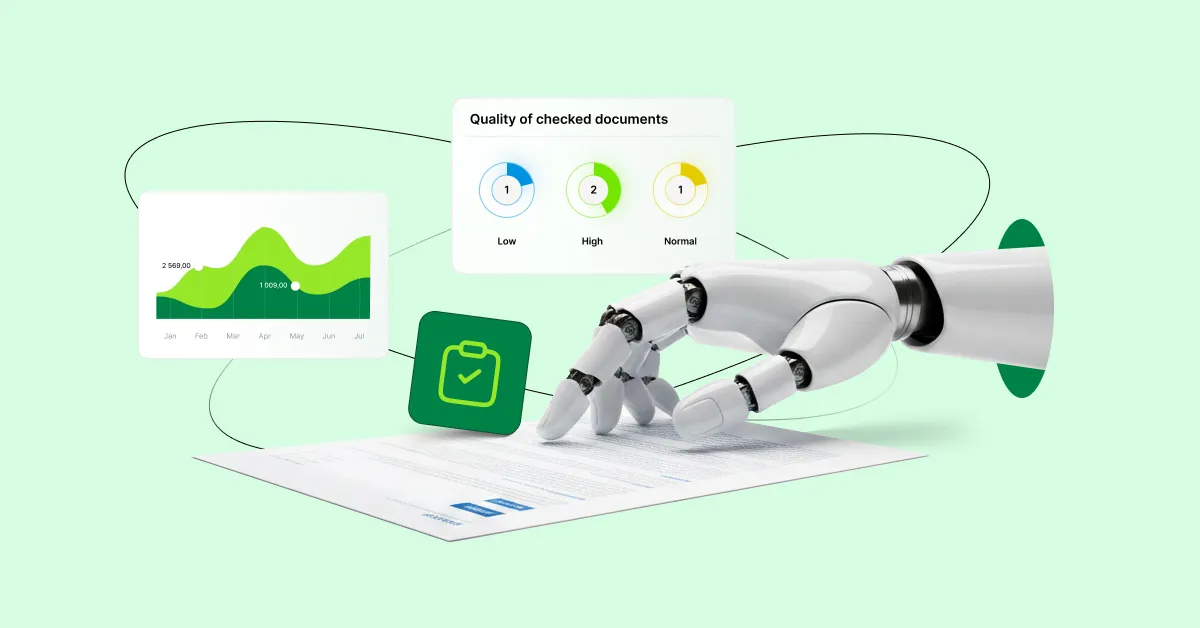
This is a criterion that can no longer be ignored. If an electronic document management system doesn’t use artificial intelligence, it is already at a disadvantage compared to solutions that can automatically extract data, highlight anomalies, analyze risks, optimize approval workflows, and partially perform tasks that previously required human intervention. Modern DMS solutions, such as SmartPoint DMS, already leverage:
- OCR (Optical Character Recognition) — converts scans, photos, and PDFs into structured, searchable text that can be analyzed and instantly passed to other systems.
- NLP (Natural Language Processing) — enables the system to understand document context: detecting incorrect phrasing, missing items, double interpretations, or deviations from templates.
- IDP (Intelligent Document Processing) — combines OCR, AI, and business logic to automatically extract key data and route documents to the correct processes.
Investing in a system without AI today means adopting technology that will become a bottleneck in a few years. That’s why it’s essential to choose solutions that already use intelligent algorithms and have a clear roadmap for developing these capabilities. In the long term, companies that integrate these tools now will have a competitive advantage over those that try to catch up years later.
However, there is an important nuance often overlooked. Current demand for AI is driven by a global market trend — but what a client perceives as AI and what major technology vendors define as AI can differ significantly. At the intersection of expectations and real-world use cases lies a key challenge: the integrator must help the business correctly align tasks with specific AI tools.
Companies primarily look for AI to reduce costs in routine operations: data entry, document verification, error detection, and so on. Yet there is a large gap between a tool that delivers real economic value and AI that sounds impressive but doesn’t address a specific need. Vendors often encounter situations where the client lacks sufficiently structured data for AI to operate effectively. In other words, the expectation of immediate results meets the reality that intelligent algorithms require a solid digital foundation, not a chaotic mix of paper and partially digitized files.
Previously, the main challenge was converting paper documents into electronic format. That challenge hasn’t disappeared — but the market focus has shifted toward AI-powered processes, where key stages such as data capture, classification, validation, extraction, and routing are performed automatically using AI algorithms. This often creates a paradox: a company has not yet implemented a fully systematic EDMS but already seeks AI automation.
Modern technologies such as OCR, NLP, and IDP genuinely help reduce operational costs, accelerate document processing, and minimize manual work. However, for these tools to reach their full potential, businesses still need to streamline processes, digitize documents, and establish a robust data management architecture. The role of a competent vendor is to help the company build a broader digitalization strategy, where AI becomes a logical extension of core processes rather than an isolated feature living outside the main workflow.
Security and Regulatory Compliance
Data protection remains a critically important factor. Ensure that the system complies with local legislation and international security standards. This is especially relevant for financial institutions, healthcare providers, and public sector organizations, where breaches in data storage or processing rules can lead not only to fines but also to loss of client trust and serious reputational risks.
An important consideration is where documents are stored and how data is controlled. Unlike external services, where clients may not know in which countries or under whose security policies their data resides, SmartPoint DMS integrates directly into the client’s infrastructure. All documents remain within the corporate perimeter, stored in certified Microsoft repositories (SharePoint, Dataverse, SQL, etc.), ensuring compliance with modern security requirements, GDPR, and high data compliance standards.
This approach guarantees data protection, integrity, and reliability: information is not duplicated in third-party systems, does not “spread” across external cloud environments, and is always maintained in a controlled, predictable ecosystem. This is the focus of SMART business in SmartPoint DMS, building document management on proven Microsoft technologies while providing a high level of reliability and data protection for clients.
User-Friendliness
Even the most powerful system is useless if employees find it difficult to use. The interface should be intuitive, and learning the system should be simple and straightforward. Ease of use directly affects the speed of implementation and the adoption of new processes by key users.
Total Cost of Ownership
Evaluate not only the license cost but also expenses related to implementation, staff training, technical support, and updates, as a seemingly cheap solution can end up being more expensive in the long run.
Support and Development
A reliable EDMS vendor should provide regular updates, technical support, and professional consulting. Pay attention to whether the system can evolve alongside your company: after implementation, the business may require additional features or customizations, and the complexity of scaling can significantly impact costs.
When choosing a DMS solution, clarify how updates are delivered: does the vendor only fix technical issues, or do they regularly add new features, update security mechanisms, and adapt the system to current market requirements? A comprehensive approach to updates ensures that the system continuously evolves to meet the company’s current needs.
For example, SmartPoint DMS receives regular updates aligned with Microsoft policies, including planned improvements for stable and secure operation, as well as new features released monthly or quarterly. This regular release cycle allows companies to work in a system that constantly evolves without incurring major additional costs or the risk of technological obsolescence.
The right solution helps optimize document workflows, reduce costs, and lay the foundation for further digital transformation — a holistic approach exemplified by SmartPoint DMS from SMART business.
How to Choose a Reliable Vendor for Implementing a DMS Solution?
When a company selects an electronic document management system, it is choosing not only the technology but also a partner who will help integrate it into real business processes. It is important to understand that an effective DMS solution is not a single module or isolated software. Electronic document management always exists within a broader business process paradigm: it interacts with ERP, CRM, HR systems, external services, and partners. Therefore, the vendor’s competence is often as important as the quality of the platform itself.
To avoid the risk of implementing a “point solution” that doesn’t scale or account for company workflows, evaluate the vendor based on several key criteria:
- Reputation and track record — a reliable vendor has years of experience working with documents, processes, and digital transformation. Experience, a portfolio of completed projects, and long-term client relationships demonstrate that the company can successfully implement a software product and provide ongoing support.
- Technology platform and approach to business needs — it is essential to assess the technologies behind a potential partner’s solution and whether they can work systematically rather than in a fragmented way.
Business needs rarely revolve around a single system. For example, SMART business takes a holistic approach: the company considers the problem more broadly, offering not just a single tool but an ecosystem of solutions and integrations that together cover the entire document lifecycle and associated processes.
This is important because a vendor offering only a single feature or a standalone AI add-on typically cannot build a full-fledged document management system. Such solutions have a narrow focus: they may automate one fragment of a process — for example, text recognition in a document — but they do not address the logic of the overall business workflow.
For instance, imagine a company wants to accelerate contract processing. A vendor selling a “point” AI tool might offer automatic field population or document classification. While useful, this does not solve the core challenge: how the contract is approved, who signs it, where it is stored, how versions are updated, what access each department has, and how the document integrates with ERP or CRM systems. Essentially, the company receives a helpful but isolated function that does not create a complete document management system.
In contrast, a vendor with a comprehensive approach, such as SMART business, views the process in its entirety: from contract creation → approval → signing → storage → versioning → analytics → integration with other internal and external systems.
This distinction is the key difference between a vendor that implements a full DMS solution and one that offers only a single feature without the ability to support the entire business process.
- Availability of consulting expertise — today, many companies want to implement AI solutions or automation but lack the expertise to maintain these technologies independently.
Therefore, it is important to choose a partner who acts not only as an integrator but also as a business consultant. The partner should explain how to build your own AI- or BI-powered ecosystem, which tools are truly necessary, and how they will impact company processes.
For example, SMART business combines technology and consulting: alongside implementing SmartPoint DMS for document management, the company helps clients build their own AI-powered ecosystem of solutions — from strategy to ongoing support.
- Ability to integrate the DMS into the company’s IT ecosystem — clients need to assess whether a vendor can integrate the electronic document management system into the existing environment: CRM, ERP, financial systems, HR services, e-signature tools, and other internal or external instruments. A DMS cannot function as an isolated “island” — documents are always connected to procurement, sales, finance, HR, or legal processes. The partner must be able to integrate the solution across all touchpoints, ensuring process continuity, automatic data exchange, and minimal manual intervention.
- Flexibility, scalability, and customization capabilities — business processes are constantly evolving: new departments are created, approval workflows change, external services are added, and document volumes grow. Therefore, it is important that the vendor provides not a fixed out-of-the-box solution, but a system that can evolve with the company.
A reliable partner should ensure the following:
- Process flexibility — the ability to quickly change approval workflows, user roles, and document logic without lengthy development cycles.
- Scalability — the system’s ability to handle higher volumes of documents and users without loss of performance.
- Customization — adaptation to the company’s specific needs rather than the other way around. This may include configuring fields, additional validations, automations, rules, integrations, etc.
Essentially, this refers to a vendor’s ability not only to configure the system “as-is” but also to co-develop and expand a document management model with the client as needs grow or change. This is exactly the approach offered by SMART business: to act as a technology partner that develops the EDMS, ensuring continuous processes, scalability, and readiness for each client’s future transformations.
How to Implement Electronic Document Management System?
The process of implementing electronic document management in collaboration with a vendor can be divided into several steps.
Step 1. Needs Analysis
Assess your company’s needs regarding electronic document management. Identify which processes need automation, which documents are frequently used, and what problems arise with paper-based workflows.
Vendor’s role: SMART business conducts in-depth process research (Discovery), maps document workflows and identifies where automation will have the greatest impact. The vendor helps determine which processes should be transformed and which tools are required.
Step 2. System Selection
Research various electronic document management systems that meet your company’s requirements. Consider their functionality, compatibility with existing systems, security, and customer support. Choose the solution that best fits your business.
Vendor’s role: SMART business proposes the optimal architecture — from document storage to integrations with CRM, ERP, accounting systems, and e-signature services. They explain how SmartPoint DMS works within the Microsoft ecosystem, where data will be stored, and possible scaling scenarios.
Step 3. Planning and Implementation
Develop a detailed implementation plan for the EDMS. Define success criteria, timelines, and resources.
Vendor’s role: SMART business creates the project roadmap, outlines risks and dependencies, configures SmartPoint DMS modules, integrates with third-party systems, and ensures quality at every stage.
Step 4. Employee Training
Ensure proper training for employees on the new system. Organize training sessions, workshops, and provide user guides. Make sure all employees understand the benefits and processes of electronic document management.
Vendor’s role: SMART business provides role-based training — from end users to process administrators. The integrator team supplies all necessary instructions, video guides, training scenarios, and answers users’ questions during the adaptation period.
Step 5. Gradual Rollout
Start by implementing electronic document management in one department or project, then gradually expand across the company. This reduces risks and allows early correction of errors or identification of potential issues.
Vendor’s role: SMART business supports the pilot, collects feedback, helps adjust processes, and adapts the system to real scenarios. Only after a successful pilot is the solution rolled out company-wide.
Step 6. Monitoring and Updates
After implementation, maintain continuous monitoring and updates. Track performance, efficiency, and user satisfaction. Make changes as needed, improve processes, and expand system functionality.
Vendor’s role: SMART business provides technical support, updates according to Microsoft policies, adds new SmartPoint DMS features, advises on process optimization, and helps scale the solution alongside the company.
Successful implementation of electronic document management is not just about installing a system; it involves changing the way a company operates. That’s why it’s crucial to have a partner who shares the workload, helps make decisions, and supports the company throughout the entire process. SMART business is ready to be that partner — from providing expertise to full-scale implementation. Simply submit a request and get a consultation tailored to your business:


