The growth of the company goes hand in hand with the growth of the flow of data and volumes of documentation. At some point, working with documents becomes cumbersome, and traditional methods of processing paper documents become less and less effective.
To solve this problem, businesses around the world are massively switching to electronic document management. And if the global market for document management software in 2019 was estimated at $4.9 billion, by 2025 this figure is expected to reach $10.2 billion (source: financesonline.com).
In this article, we will introduce you to the concept of electronic document management and find out the advantages of its implementation in business processes.
What is electronic document management?
Electronic document management (also known as EDM) is a system for exchanging and processing documents in electronic format. It replaces traditional paper documents and enables organizations to efficiently manage, store, share and collaborate on records in a digital environment.
Electronic document management includes the creation, editing, signing, registration, storage and transfer of documents in digital form. For this, special software tools are used to create electronic versions of records, store them in digital form, and also ensure secure data exchange between participants in the process.
Why is electronic document management better than paper one?
EDM has several advantages over traditional paper documents. They include:

Productivity
Digitization allows you to quickly exchange documents, reducing the time for their transportation, search and distribution.

Saving resources
The use of electronic documents reduces the cost of paper, printing, postage and other costs associated with paper documents.

Convenience
You can easily find, view and edit records, and several users can work on files at the same time.

Security
EDM provides a high level of data protection and confidentiality.
Types of electronic document management
EDM can be classified based on various criteria such as types of documents and volumes of data exchange. Below are more detailed descriptions of its main types, as well as a classification by type:
- Internal
This type involves the exchange of documents within the same organization. It is used to streamline internal workflows, simplify communication between departments, and speed up decision making. Internal electronic document management may include various types of documents, including those related to HR, management, warehouse, accounting, archive, etc. . - External
This type of EDM involves the transfer of data and documents between different companies, government agencies or partners. It allows you to automate document exchange processes, avoid errors and reduce the time required for processing and approval of documents. External electronic document management may include records related to orders, contracts, invoices, logistics, licenses, etc.
Classification by types of documents:
HR electronic document management
Covers records related to HR processes such as job applications, changes of employee’s data, vacations, dismissals, etc. HR EDM is the optimal solution for the remote work format, it saves time and reduces the workload on the HR department.
Managerial
These are documents related to management activities, in particular, reports, presentations, development plans, strategic documents, etc. They are used to make decisions at different levels of management.
Warehouse
Related to warehouse accounting, in particular invoices, acts of acceptance and transfer of goods, inventory information, balance reports, etc.
Accounting
Related to financial accounting and reporting, including invoices, tax returns, income and expense reports, financial statements, etc.
Archive
Covers information to be stored in archives for a long period of time. These can be documents on the internal operations of the organization, contracts, reports, extracts from minutes, internal orders, etc.
This classification includes only the main types of documents in the context of EDM, but there may be other specific types that meet the needs of a particular organization or industry.

How to introduce electronic document management in your business?
The implementation process can be divided into several following steps:
Step 1. Need analysis
Actions to take: Assess your company’s needs for electronic document management. Determine which processes need to be automated, which documents are frequently used, and what problems arise with paper document flow.
Step 2. Selecting the system
Actions to take: Explore different electronic document management systems that meet your company’s needs. Consider their functionality, compatibility with existing systems, security, and customer support. Choose the solution that best suits your business.
Step 3. Planning and implementation
Actions to take: Develop a detailed EDM implementation plan. Define success criteria, timelines and resources.
Step 4. Employee training
Actions to take: Ensure that employees are properly trained in the use of the new system. Organize learning sessions, trainings and provide manuals on the use of the system. Make sure all employees understand the benefits and processes of electronic document management.
Step 5. Gradual implementation
Start with the implementation of electronic document management in one department or project, and then gradually expand it to the entire company. This will reduce risks and allow you to correct errors or identify possible problems at an early stage.
Step 6. Monitoring and updating
Once the system is implemented, ensure continuous monitoring and updating. Keep track of performance, efficiency and user satisfaction. If necessary, make changes, improve processes and expand the functionality of the system.
The introduction of electronic document management system can greatly facilitate the work of your company, reduce costs and increase productivity. It is important to have a clear plan, involve all stakeholders and provide proper training. Gradual implementation and continuous monitoring will help ensure the successful use of the electronic document management system.
How to choose an EDM system?
When choosing an electronic document management system, it is important to consider several key aspects, including functionality, integration with other systems, security, scalability, and user interface convenience.
If you are actively looking for such a system, we recommend that you pay attention to SmartPoint DMS. It meets all the criteria described above, and also offers a number of additional benefits, such as collaboration on documents, work with EDS (QES), customization of document approval routes, and access from mobile devices.
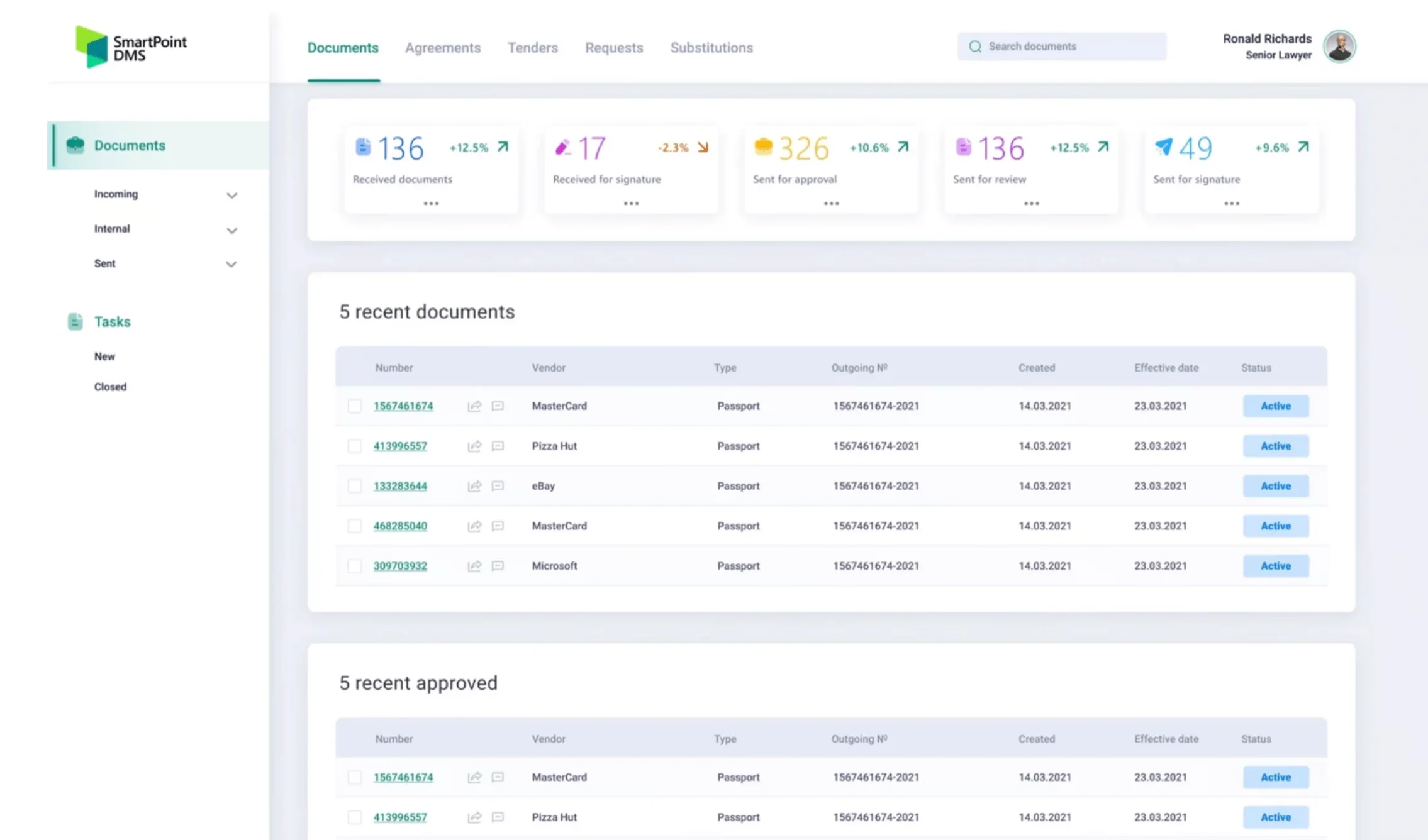
SmartPoint DMS is based on Microsoft technologies and includes a set of tools for monitoring, managing and storing various types of documents, maximizing the efficiency of each business process. The solution includes several modules that allow you to close the entire list of issues related to internal and external documentation, including the contracts module, correspondence, tenders, and purchases.